3.01.2017

Abolitionist, Writer Grace Greenwood 1878

[WOMEN-LITERATURE] ALS, Handwritten Letter by 'Grace Greenwood', pseudonym of Sara J. Lippincott, Sara Clarke: writer, activist, abolitionist. Washington DC: 1878. Two sided letter, dated April 9, 1878 on chain lined paper, lightly foxed. She writes from Washington DC to unknown recipient:

Dear Friend, Thanks for your kind good letter of yesterday - I wish I had applied to you in better time. As it is I cannot well wait til June 20th - besides not hearing from you for [..]. I have written to engage passage on our favorite German, the City of Berlin for June 8th [ed. likely referencing SS Berlin, debut 1875, known as fastest liner on Atlantic]. Believe me dear friend of old time, as truly yours now as ever S. J. Lippincott.

Lippincott/Grace Greenwood's earliest writing was poetry and children's stories, publishing locally. In 1844 at the age of 21, she was published in the New York Mirror and she would go on to receive significant critical attention and be published widely, while rising within the NYC literary circles.

Greenwood was the first woman reporter on the New York times. She joined the National Era, a weekly abolitionist newspaper, and copy edited the original, serialized version of Harriet Beecher Stowe's Uncle Tom's Cabin.

She lectured extensively before and during the Civil War, emphasizing her abolitionist stance and social issues as prison and asylum reform, and a call to end capital punishment. President Abraham Lincoln referred to her as "Grace Greenwood the Patriot". After the war, women's rights became a focus. By the 1870s, the majority of her writing was done for the New York Times, with articles on Fanny Kemble's right to wear trousers, Susan B. Anthony's right to vote and equal pay for equal work. Very good. Letter. $225.00

2.09.2017

Wellesley College Small Press Beauty - Female President

A lush, elegant, decadent hand-feel jewel, from a prominent female leader:


[WOMEN-LITERATURE] Caroline Hazard . The Illuminators. Campden, Gloucestershire : Essex Press , 1905. Limited Edition. The Illuminators By Caroline Hazard, MA LITT.D. LL.D. A Poem Read at the installation of the Eta chapter of the Phi Beta Kappa society at Wellesley College January 17, 1905. Privately printed 129/15. String tied in original letterpressed wraps, three color print with pictorial devices, uncut handmade paper, lovely punch to wraps. One small spot to interior, otherwise fine. Near fine. Wraps.

Caroline Hazard was the first Wellesley president to have a formal inauguration. Hazard, who held no formal college degree, was responsible for putting the College back on a sound financial footing. Hazard hired the noted landscape architect, Frederick Law Olmsted, Jr., to help develop the Wellesley College grounds. Under Hazards' aegis, and sometimes with her personal financial support, a number of buildings were constructed: the Observatory and Observatory House, the dormitories of the Hazard Quadrangle, and the Library. They carry her symbol, the scallop shell. She retired in 1910, but continued as a Wellesley College trustee until 1927. She died in 1945.


6.17.2016

 'O Death, whose sceptre trembling realms obey.. '


Wheatley, Phillis. To Mr. And Mrs. ******* on the Death of their Infant Son., in The Boston Magazine for September, 1784 [p. 488]. Printed on the 'North Side of the Market', Boston by Greenleaf and Freeman in 1784, this issue notable for the first printing of 'On the Death of an Infant', by Phyllis Wheatley (1753-1784) published three months shy of her early death. 

From The Heath Anthology of American Literature, Editor Paul Lauter, William H. Robinson (Rhode Island College) and Phillip M. Richards (Colgate University): Known for her Christian verses reflecting orthodox piety, Phillis Wheatley wrote on a wide variety of topics. A kidnapped African slave child she was sold from the South Market in Boston to well-to-do Susanna Wheatley. She was raised in a pious Christian household, tutored by family members, quickly learning English, Latin, and the Bible, and she began writing in 1765, four years after arriving in Boston harbor. in 1767, when she was about thirteen or fourteen years old, Phillis Wheatley published her first verses in a Newport, Rhode Island, newspaper. By 1772 she had composed enough poems to advertise twenty-eight of them in The Boston Censor for February 29, March 14, and April 11. She hoped to publish a volume of her poems that year in Boston.


The range of her topical concerns was already evident in these twenty-eight titles. Along with poems on morality and piety, the volume offered patriotic American pieces, an epithalamium, and a short, racially self-conscious poem, “Thoughts on Being Brought from Africa to America.” Had enough subscribers for this volume come forward, it would have been printed. But advertisements brought no subscribers, for reasons in part racially motivated. Wheatley was encouraged by her doting and undaunted mistress to revise her manuscripts in preparation for a volume that Susanna Wheatley had arranged, with the prestigious cooperation of the Countess of Huntingdon, to have published in London in 1773, complete with an engraved likeness of the poet as a frontispiece. This was the first volume known to have been published by a black American, man or woman.

In the fall of 1779, she ran (six times) proposals for a projected third volume, of thirty-three poems and thirteen letters. The work was to be dedicated to Benjamin Franklin. But again, as in 1772 and 1773, these 1779 proposals were rejected by Bostonians. In the Boston Magazine for September, 1784, there would be printed a final solicitation for subscribers to this third volume, but there would be no such book in print by the time Phillis Wheatley died three months later on December 5.

As some know, sometime before October 8, 1772, a semi-circle of 18 of the most prominent New Englanders adjourned to validate or debunk her poetical stature. All men, all white men, near all Harvard grads, all slave holders, many slave traders... and.. she 'passed'. 

Still no American publisher would take her manuscript, still 6-fold and more pleas for subscription fell short, still she would be buried in an obscure grave, two babies gone before, a husband long gone, alone but for her third baby, who died with her. 

They, those that tolerated the verses of her existence while still part and parcel of the very society that weakly, scarcely allowed her own selfhood to be, wrote: 'We whose Names are under-written, do assure the World, that the poems specified in the following Page, were (as we verily believe) written by Phillis, a young Negro Girl, who was but a few Years since, brought an uncultivated Barbarian from Africa, and has ever since been, and now is, under the Disadvantage of serving as a Slave in a Family in this Town." 


She died a free woman,  just three months after her final advertisement in the September '84 Boston Magazine, in which she penned [what I am inclined to think] her own elegy to the death of an infant son, written toward a 'Mr.' and a 'Mrs.', seemingly an autobiographical verse of self-comfort. Attempts to strip her faintly won title of ‘poet’ persist. Thomas Jefferson, unsurprisingly, dismissed her as a poet, for her lack of 'animating intellect'. More surprisingly, Amiri Baraka joined in the chorus of ridicule, claiming her voice a 'far, ludicrous departure from the huge black voices.. '. Others continue to paint her as merely an Aunt Tom. Henry Louis Gates, Jr., in his excellent 2003 New Yorker piece, ‘Phillis Wheatley On Trial’,  pointedly asks us to imagine a bicentennial retrial of her craft and expression.

No century yet less hostile for a young, black, small, female voice.


The cruelest lies are often told in silence.   --Robert Louis Stevenson


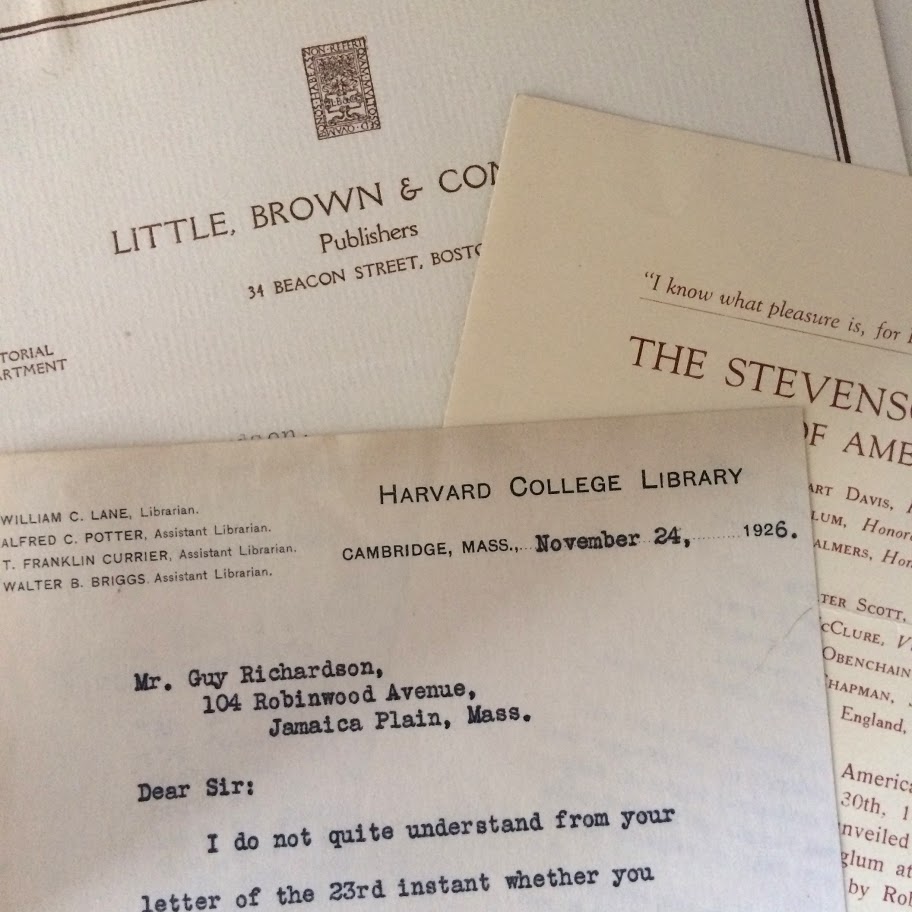
.[LETTERS - AUTHORS] 1920s Robert Louis Stevenson Club, Stevenson Society Club and other RLS related letters and ephemera, in which an illegitimate son born in Scotland is both confirmed and denied. Edinburgh: ca 1924. All notes addressed to Guy Richardson, Esq. of Boston:

1166.JPG


TLS marked private and confidential, from the Hon. secretary of the Robert Stevenson Club, Edinburgh, 1924, regarding illegitimate son to R.L.S.
TLS, 2pp., on Little Brown and Co. letterhead, from Herbert F. Jenkins, 1925, regarding illegitimate son to R.L.S.
TLS, The Stevenson Society of America, Inc. Saranac Lake, New York, from Livingston Chapman, 1925, regarding purchase of cottage, Society plaque, etc.
TLS, Harvard College Library letterhead, William C. Lane, Librarian at Harvard Library, 1926, Widener catalog, Stevenson collection, Lincoln, etc.
TLS, half-tone illustrated letterhead, Stevenson Society of America, Inc., from Livingston Chapman, 1930, enclosing photograph of Poultney Bigelow, etc. Folding leaflet printed in sepia, Stevenson Society of America Application for Membership.

In the 1925 letter on Little, Brown and Co. letterhead from Herbert Jenkins, he quotes John A. Steuart, confirming a child born October 5th, 1879 in Alva, Clackmannanshire.. funds were directed to the child via Charles Baxter, but by 1925, he is living in cold charity 'for the Edinburgh that raves about R.L.S. gives him the cold shoulder'.. Fine. Letter. Click to purchase

6.05.2016

1909 Small handmade Victorian era birch bark souvenir from Good Hope Camp Snowshoe Trip, with menu.  12pp of birch bark paper, tied with cord. Cover and two interior pages with text - menu:


Clam Chowder
Welsh Rabbit
Radishes
Cake
Pie
Cookies
Coffee
Guests are named on another page.

I’ve handled several birch bark albums from the Victorian to the Deco era, generally from New England and North Eastern Canada. While this little souvenir is simply bark, with text in ink and likely given as a gift of remembrance or friendship, often the birch bark ‘paper’ is mounted onto stiff paper or boards, much like an albumen photo.

Item v  in a recent micro-catalog, ‘Last of May’.

A recent example, the mounted variety, hand-painted quite well and used as a photo album: